Industrial Incident Investigation Techniques

Thomas V. Rodante, P.E., CFEI, CFII
Baker Engineering and Risk Consultants Inc., USA

Presented at International Symposium on Fire Investigation, 2012

ABSTRACT
NFPA 921 provides an excellent framework for individuals charged with the responsibility of investigating fire and explosion incidents. NFPA 921 establishes systematic investigative and analytical scientific techniques around the core principle of scientific methodology. Guidance is provided in NFPA 921 to show and explain the process of evidence collection, analysis, hypotheses formulation, forensic hypotheses testing, hypothesis correction and re-testing, and final cause determination. This presentation provides case study examples, not offered within NFPA 921, of forensic scientific methodology as applied to industrial petrochemical processing incidents.

Specific potential industrial evidence types are discussed and examples provided. The use of a timeline spreadsheet beyond that explained in NFPA 921 is shown with examples of how to correlate process data to witness statements. A case study scenario supposition and hypothesis spreadsheet is provided to show an example method for organizing observations, list related hypotheses, determine forensic test criteria, and document results. The provided example includes scientific forensic use of flame and vapor dispersion modeling, and metallurgical analysis. Finally, an example fault tree is shown as an alternative analytical method for cases in which the existence of physical evidence may be limited.

Download the complete paper here

October 7, 1871: Most Devastating Fire in US history

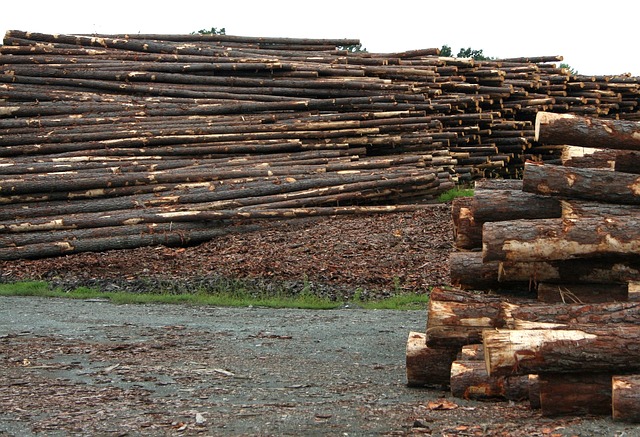
The most devastating fire in United States history is ignited in Wisconsin on October 7th, 1871. Over the course of the next day, 1,200 people lost their lives and 2 billion trees were consumed by flames. Despite the massive scale of the blaze, it was overshadowed by the Great Chicago Fire, which began the next day about 250 miles away.

Peshtigo, Wisconsin, was a company lumber and sawmill town owned by William Ogden that was home to what was then one of the largest wood-products factories in the United States. The summer of 1871 was particularly dry across the northern Midwest. Still, settlers continued to set fires, using the “slash and burn” method to create new farmland and, in the process, making the risk of forest fire substantial. In fact, the month before had seen significant fires burn from Canada to Iowa.

Peshtigo, like many Midwestern towns, was highly vulnerable to fire. Nearly every structure in town was a timber-framed building–prime fuel for a fire. In addition, the roads in and out of town were covered with saw dust and a key bridge was made of wood. This would allow a fire from outside the town to easily spread to Peshtigo and make escaping from a fire in the town difficult. On September 23, the town had stockpiled a large supply of water in case a nearby fire headed in Peshtigo’s direction. Still, they were not prepared for the size and speed of the October 7 blaze.

The blaze began at an unknown spot in the dense Wisconsin forest. It first spread to the small village of Sugar Bush, where every resident was killed. High winds then sent the 200-foot flames racing northeast toward the neighboring community of Peshtigo. Temperatures reached 2,000 degrees Fahrenheit, causing trees to literally explode in the flames.

On October 8, the fire reached Peshtigo without warning. Two hundred people died in a single tavern. Others fled to a nearby river, where several people died from drowning. Three people who sought refuge in a water tank boiled to death when the fire heated the tank. A mass grave of nearly 350 people was established because extensive burns made it impossible to identify the bodies.

Despite the fact that this was the worst fire in American history, newspaper headlines on subsequent days were dominated by the story of another devastating, though smaller, blaze: the Great Chicago Fire. Another fire in Michigan’s Upper Peninsula that consumed 2 million acres was an even smaller footnote in the next day’s papers.

Source: History.com


ISFI 2016 wrap-up

Last week was ISFI 2016 at the beautiful McCormick Ranch in Scottsdale, Arizona.

We had over 40 presentations on a variety of fire investigation science and technology topics! Thank you to all of our speakers and all of those who submitted high quality papers of their research and experience, we are so grateful for your desire to share and give back to our community. Over 125 delegates joined us from eight countries.

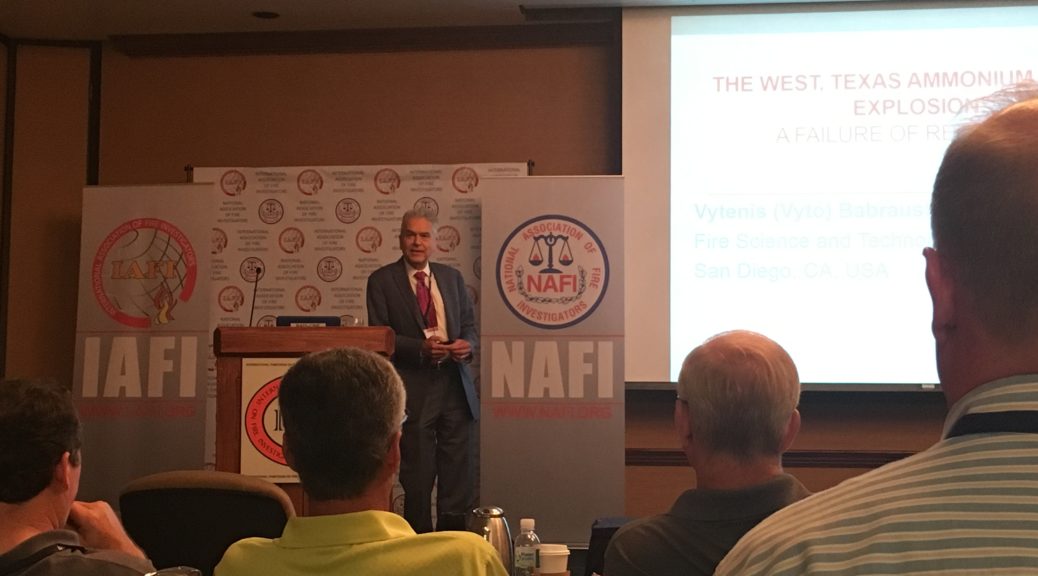
isfi2016_speaker_greg
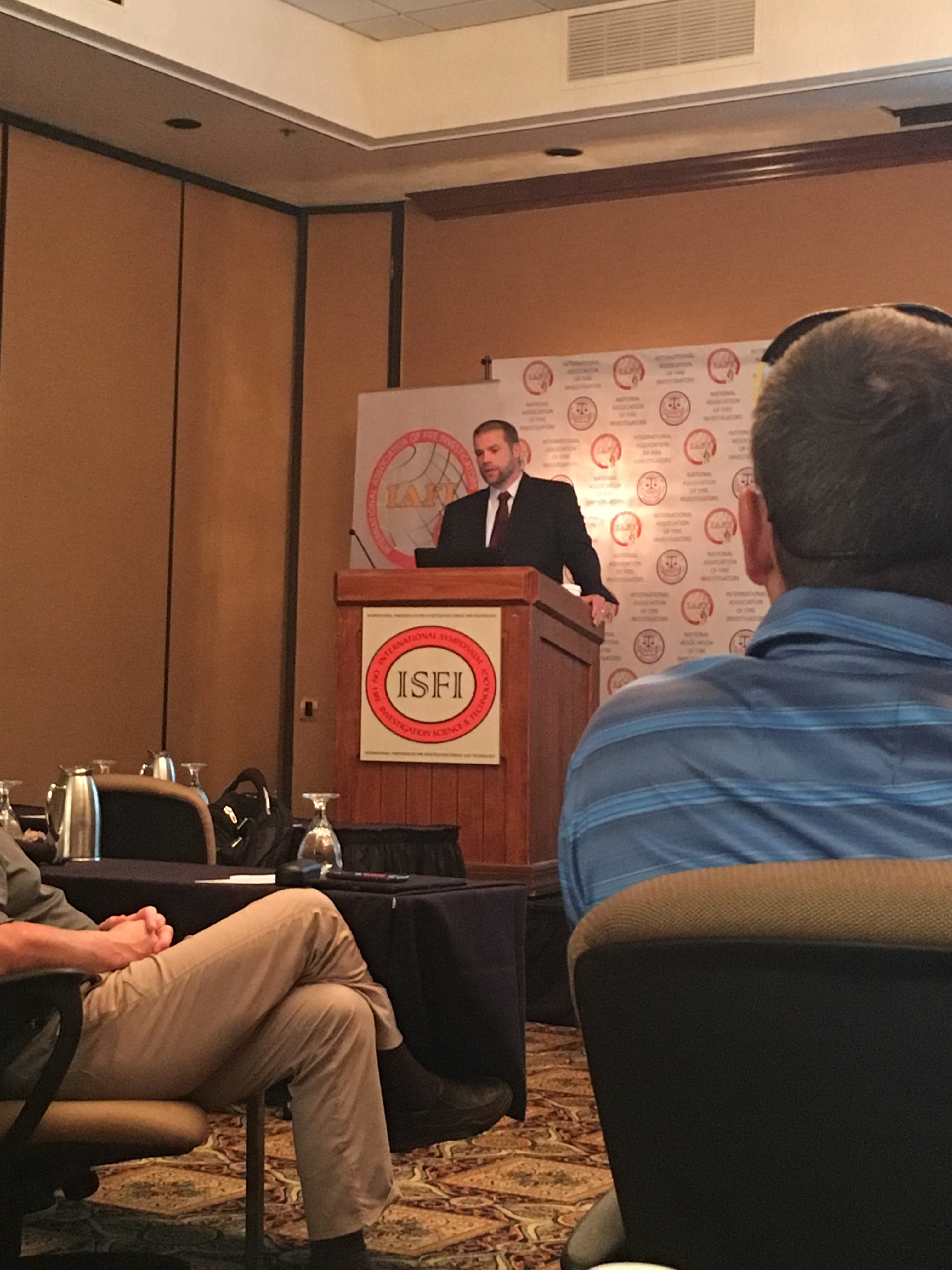
Gregory Corbett speaking at ISFI 2016

We also want to thank several individuals who contributed time and effort to ISFI 2016 – Gregory Corbett, Ron Hopkins, Vyto Babrauskas, Scott Davis, Wayne Chapdelaine, Kevin Lewis, and Jim Shanley. Without them, ISFI 2016 would have gone on, but it wouldn’t have been nearly as much fun.


Deposition Testimony: Don’t Fall Prey to Lawyer Tricks

Karrie J. Clinkinbeard, J.D., CFEI
Armstrong Teasdale LLP
and
Gerald A. King, J.D., CFEI
Armstrong Teasdale LLP

Presented at International Symposium on Fire Investigation, 2014

ABSTRACT
After an expert completes the origin and cause investigation, has carefully reviewed all available data and thoroughly researched the methodology and conclusions, the upcoming deposition should be easy, right? Not if you are unaware of tricks lawyers use to shape the testimony in the manner the adverse lawyer desires. Even the most qualified experts who have followed all elements of the scientific method in formulating their opinions are at risk if they are not sufficiently prepared to handle the opposing lawyer’s tricks. An adverse lawyer’s goal during a deposition is to have the expert say something they did not mean to or say it in a way that harms that party’s case. Lawyers craftily lay a myriad of traps when questioning an expert, especially with experts who are strong advocates for their clients. This article highlights some of the most effective lawyer tricks and provides advice on how to successfully navigate them. The presentation will contain video clips of actual depositions where these lawyer tricks are used, providing real world examples of what to do (and not do) and how to recognize when the adverse lawyer is setting you up.

Download the complete paper here


Minnesota town burns on September 1, 1894

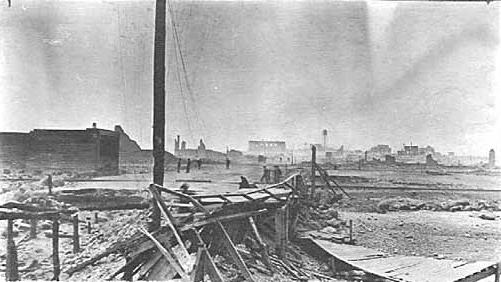
The town of Hinckley, Minnesota, is destroyed by a forest fire on this day in 1894. A total of 440 people died in the area.

The upper Midwest was particularly vulnerable to devastating fires at the end of the 19th century as European settlers cleared the land for agriculture and timber and new railroad lines were built through heavily wooded areas. Hinckley was a new lumber and rail town built along the Grindstone River in Minnesota near the Wisconsin border. The town’s settlers felled trees for lumber using slash cutting techniques that left behind large amounts of wood debris—excellent fire fuel. Further, they set up lumber yards very close to the rail lines. This proved a dangerous combination when sparks from trains set the wood debris ablaze.

In the summer of 1894, drought conditions in the Upper Midwest made a deadly fire even more likely. On the afternoon of September 1, fires near two rail lines south of Hinckley broke out and spread north. As the raging fire reached the town’s train depot, 350 of the townspeople got on a train to escape. The train had to pass right through flames, but reached safety in West Superior, Wisconsin.

Other Hinckley residents sought refuge in the swamps near town, but many in this group were killed, some from drowning. About 100 other residents fled to a gravel pit fill with water; most managed to survive. A train that was entering Hinckley from the north reversed direction to avoid the blaze, but still caught fire. The only survivors were those who managed to jump from the train into a lake.

In all, 300,000 acres of town and forest burned in the fire, causing about $25 million in damages. In Hinckley, 228 people died. More than 200 others in the surrounding areas also perished, including 23 Ojibwa natives.

Source: History.com
Image: Wikipedia.org


Emergency Response to Incidents Involving Electric Vehicle Battery Hazards: Full-Scale Testing Results

R. Thomas Long Jr. and Andrew F. Blum
Exponent, Inc., USA

Presented at International Symposium on Fire Investigation, 2014

ABSTRACT
Fires involving cars, trucks, and other highway vehicles are a common concern for emergency responders. Between 2009 and 2011, there was an average of approximately 187,500 highway vehicle fires per year.  Fire Service personnel are accustomed to responding to conventional vehicle (i.e., internal combustion engine [ICE]) fires, and generally receive training on the hazards associated with those vehicles and their subsystems. However, in light of the recent proliferation of electric drive vehicles (EDVs), a key question for emergency responders is, “what is different with EDVs and what tactical adjustments are required when responding to EDV fires?”

The overall goal of this research program was to develop the technical basis for best practices for emergency response procedures for EDV battery incidents, with consideration for suppression methods and agents, personal protective equipment (PPE), and clean-up/overhaul operations. A key component of this project goal was to conduct full-scale fire testing of large format Lithium-ion (Li-ion) batteries as used in EDVs.

This article summarizes the full-scale fire tests performed, reviews the current emergency response tactics, and discusses what, if any, tactical changes relating to emergency response procedures for EDV battery incidents are required.

Download the complete paper here


Today in history: Fire on Saudi jet kills 301

On this day in (August 19) 1980, a fire aboard a plane bound for Saudi Arabia forces an emergency landing.

The Saudi Airlines flight began in Karachi, Pakistan, headed for Jidda, Saudi Arabia, with a stopover in Riyadh. The first leg of the flight was uneventful, and the Lockheed L-1011 took off from Riyadh with no problems. Shortly after takeoff from Riyadh, the pilot reported a fire onboard the plane and told air-traffic controllers that he needed immediate clearance to head back to the airport.

The fire started while passengers onboard were cooking with a portable butane stove. Apparently, this was not unusual, as Middle Eastern airlines are often willing to accommodate their Muslim passengers’ needs to follow the strict dietary laws of their religion. The pilot was able to land the plane back at Riyadh safely and headed to the end of the runway where a rescue crew was waiting.

When the plane reached the end of the runway, however, it burst into flames. The crew sprayed fire-fighting foam at the fire, but it was no match for the intense blaze. None of the 301 people onboard escaped the fire. It is still unclear why there were no survivors. Bodies were found piled up near the escape hatches. One theory is that panic on the plane caused a stampede that prevented the hatches from being opened. Another possibility is that the crew failed to depressurize the cabin, which would have prevented the hatches from opening. It is also possible that everyone on the flight was overcome by fumes before they could save themselves.

Source: History.com


Explosion Severity: Propane versus Natural Gas

Alfonso Ibarreta, Ph.D., PE, CFEI,
Timothy Myers, Ph.D., PE, CFEI, CFI,
James Bucher, Ph.D., CFEI and
Kevin Marr, Ph.D., CFEI
Exponent, USA

Presented at International Symposium on Fire Investigation, 2012

ABSTRACT

Natural gas, composed mainly of methane, is in some ways similar to propane gas. Both fuels have similar energy densities per unit mass, and similar laminar premixed flame burning velocities. However, propane explosions have been shown to produce higher overpressures in unconfined explosion tests when compared to methane. In vapor cloud explosion modeling, methane is considered to be a “low” reactivity fuel, while propane is listed as a “medium” reactivity fuel. In closed vessel explosion testing, the maximum rate of pressure rise for propane is almost twice than that for methane (based on KG  values reported in NFPA 68 (2007) Standard for Explosion Protection by Deflagration Venting , table E.1).

This study provides a direct comparison of the explosion severity between commercial propane and natural gas. Empirical correlations available for vented vessel explosions and unconfined Vapor Cloud Explosions (VCEs) are used to predict the difference in overpressure expected for a commercial propane explosion versus natural gas explosion. Although the maximum laminar burning velocity associated with propane is only about 15% higher than that associated with methane, commercial propane explosions are expected to result in overpressures that are about 40% higher than that of a natural gas explosion under identical conditions with a perfectly-mixed nearstoichiometric fuel-air mixture, based on empirical correlations.

In addition to the laminar burning velocity, other fundamental differences in the fuels may also play an important role in the explosion severity. Propane has a slightly higher expansion ratio than methane when undergoing combustion. The mass diffusivity of propane and methane are also quite different, making the premixed propane flame more prone to wrinkling under turbulent conditions. Future testing in the 20-L explosion chamber is suggested.

Download the complete paper here

“Breaking Bad” – Investigating Fires From Chemicals and Chemical Reactions

Elizabeth C. Buc, PhD, PE, CFI
Fire and Materials Research Laboratory LLC

Presented at International Symposium on Fire Investigation, 2014

ABSTRACT

Under some conditions, chemicals that are otherwise stable can react, evolve heat and cause a fire, detonate or explode. The fire investigator has to identify the chemical reactants, the reaction products and conditions that supported ignition and flame spread. A chemical fire investigation flow diagram and real-world examples of fires involving chemicals are presented to assist the fire investigator in processing chemical fires. Examples of chemical fires include self-heating, a thermite reaction, a runaway reaction from mixing incompatible materials and reactions generating hydrogen gas. Factors contributing to chemical fires such as size or quantity of material, confinement, contamination and upset process conditions are identified. Sampling, chemical analyses, literature review, and/or testing proposed or potential adverse chemical reactions are required to establish the root cause of a chemical fire.

Download the complete paper here


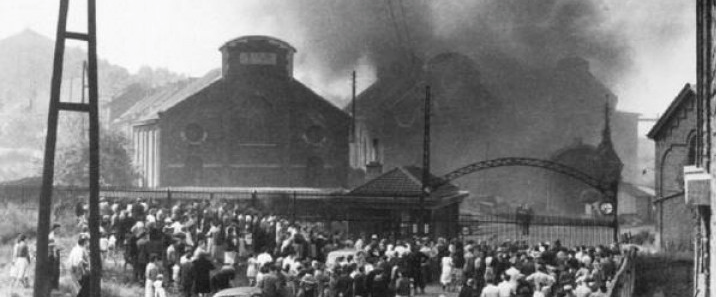
Fire Traps 262 Miners on August 8, 1956

A coal-mine fire kills 262 workers in Marcinelle, Belgium on August 8, 1956. This highly publicized disaster was the worst ever in a Belgian mine and led to many policy changes.

The disaster itself was typical of coal-mine tragedies. An accident began at 8:10 AM when the hoist mechanism in one of the shafts was started before the coal wagon had been completely loaded into the cage. Electric cables ruptured, starting an underground fire within the shaft. The moving cage also ruptured oil and air pipes which made the fire worse and destroying much of the winch mechanism. Smoke and carbon monoxide spread down the mine, killing all the miners trapped by the fire. With the families of the miners waiting aboveground at the scene, it was not until August 23—more than two weeks later—that rescue workers could reach the deepest level of the mine. Reportedly they said, “tutti cadaveri” immediately, which is Italian for “all corpses.”

The rescue workers were speaking Italian because the majority of workers at the Le Bois du Cazier mine were Italian. At the time, Belgium was experiencing a labor shortage and had made agreements with Italy to trade work visas for coal. The tragic fire resulted in 136 Italian workers losing their lives; the immigration agreement between the two countries was terminated immediately. Despite an attempted rescue from the surface, only 13 of the miners who had been underground at the time of the accident survived. 262 were killed, making the mining accident the worst in Belgian history.

Belgium also called a conference on safety in coal mines in the aftermath of the disaster. In September 1956, the Mines Safety Commission was established. It was charged with monitoring safety procedures and developing new regulations. The country’s prompt response to the disaster led to much improved safety in Belgian and other European mines.

Source: History.com and Wikipedia.com
Photo from: MinedHistoires.org